Vesion dated 21 Apr 2025
Shortcuts (links)
Section A – Constitution
Section B – General Rules, Affiliations and Facilities Criteria
Section C – Player Eligibility and Registration
Section D – Fixtures
Section E – Divisions, Promotion and Relegation
Section F – Match Day Preparation
Section G – Playing Rules
Section H – Rain and other Interruptions
Section J – Cancellations and Concessions
Section K – League Points and League Tables
Section L – Reporting Results etc.
Section M – Youth Players
Section N – Umpires
Section O – Sanctions for breaking League Rules
Section P – Disciplinary Process
Appendix 1 – Recreational Cricket Regulations (RCR)
Appendix 2 – Spirit of the Game
Appendix 3 – ECB Guidance on Thunder & Lightning
County-wide Level: Divisions 1 to 5
Regional Level: Divisions 6A, 6B and 7A, 7B
District Level: Divisions – 8A-D, 9A-E
The primary objective of the League is to facilitate competitive league cricket in the Gloucestershire region, and further the cause of cricket at all levels to encourage improvement in standards in the club game. The Saturday League consists of divisions in a pyramid structure, where teams in lower levels are split into geographic areas to reduce travel. The League exists primarily to manage Saturday adult matches, but is not limited to that. The League will encourage recruitment and training of match officials and club volunteers, and may use its funds for this purpose.
A Management Committee is elected annually at the AGM: Chairman, Treasurer and four members representing the areas shown below.All clubs will vote for Chairman and Treasurer. Clubs in each area (as defined by membership of the cricket associations) will vote for their area representative, one vote per club. For 2025 the Area Representatives are
The Committee powers and responsibilities: It must manage the League in accordance with this constitution & rules. It will create sub-committees, making appointments or co-opting. It is empowered to deal with any matter directly or indirectly affecting the League and covered by these rules or the spirit of these rules.
The Area Representatives are the first port of call for all clubs contacting the League Management Committee.
Members of the League will be clubs with teams accepted into the League that meet all the conditions set out in the rules below for affiliation, facilities, etc.
At AGMs and EGMs on matters affecting the whole league each club will have one vote. Where there are proposals affecting only a part of the pyramid, each team in that part will have one vote.
The GCL will be dissolved by a vote of more than 50% of member clubs at an AGM or EGM. Any money held by GCL will be transferred to successor organisation(s) pro rata per team.
Clubs must be affiliated to the England and Wales Cricket Board (ECB). Clubs in the Gloucestershire Cricket Foundation (GCF) area must affiliate to the GCF. Clubs in other areas must affiliate to their own county board and also be an external affiliate of the GCF. The GCF may also require clubs to be affiliated to a more local cricket association (e.g. a District Cricket Association). All clubs must affiliate to the League, paying the League affiliation fee as set by the League AGM. Fees for these mandatory affiliations will be invoiced in January or February of each month and must be paid by the end of March. Failure to do so may invalidate any League games played until the fee is paid.
All clubs must have a fully documented constitution available for inspection and a committee elected at an AGM. The club constitution must contain the words membership shall be open to all irrespective of age, disability, race, ethnic origin, creed, colour, social status and sexual orientation.
All clubs must have a current Club Safeguarding Officer, registered with the GCF. All clubs must have adopted and implemented the ECB Safe Hands – Cricket’s Policy for Safeguarding Children, and any future versions of the policy. All clubs must have Public Liability Insurance.
Failure to comply with these requirements will result in the club being expelled from the league.
All clubs must have a play-cricket website.
The GCL is a Saturday league. Apart from special circumstances, shown in the section on Fixtures, all games will be played on Saturdays.
Clubs must keep the contacts listed on play-cricket up-to-date and play-cricket will usually be used to address emails. The League may contact or need to look up your Chairperson, Hon. Secretary, Hon. Fixture Secretary, Hon. Treasurer, Club Safeguarding Officer (all are held and updated in the About Us
page). Team contacts (captain and alternative) are located in the Teams
page of play-cricket and must be updated there, using the slot for Team Manager
for the alternative team contact.
Note that some clubs show their captains in About Us.
Captain names placed there are ignored by the system. Put them and update them in Teams
please.
Before the season the League will send out contact lists showing Hon. Secretary, Captain, and alternative match day contact for each team a club is likely to have to communicate with.
Clubs in Gloucestershire relegated from WEPL will be accepted into the top division of the GCL if they apply for membership. Teams newly formed, including new teams of a club that already plays in GCL will join at the lowest level. A team wishing to transfer from another competition between seasons may be accepted, and the Committee will attempt to assess the team’s strength based on its playing record in the season before the transfer, to place the team at an appropriate place in the pyramid to avoid gross mis-match in strength. To be accepted, teams must have a ground or grounds that meet the facilities criteria below at the appropriate level.
A GCL official will usually visit the ground of a club entering the league where the facilities are not already known by the League. A GCL official may inspect any ground before, during or after the season, notifying the club in advance that this is to happen, to check that the facilities are maintained, or promised improvements are being made.
FACILITIES CRITERIA TO BE MET BY ALL TEAMS
The criteria in the next sections should be regarded as aspirations for all grounds that do not meet them. Teams that do not meet the facilities mandated for the level above them will only be promoted to that level if there is a plan to make the improvements required in the closed season, and failure to make the improvements by the start of the season will result in a penalty of 10 league points for every game until the work is done.
Additional facilities etc.
| Div 1-2 | Div 3-5 | 6A,B and 7A,B | 8A-D | 9A-E | |
| Grass pitch | Yes | Yes | Yes | Yes | Either |
Artificial (not Flicx) pitch | See below | Either | |||
| Fielding circle markers | Yes | Yes | |||
| Flat sheet or roll-on covers* | Yes | Yes | Yes | ||
| Sight screens | Yes | Yes | |||
| Powered roller (own or contractor's) | Yes | Yes | Yes | Yes | |
| Separate, lockable, changing rooms | Yes | Yes | Yes | Yes | |
| Showers, at least 2 for away team priority use | Yes | Yes | Yes | ||
| Lockable umpire's room | Yes | ||||
| Umpire coats | Yes | Yes | Yes | Yes |
* Teams in higher divisions should be equipped with roll-on covers, if at all possible
Teams in the Div 9 level may play on artificial pitches (not Flicx
pitches) that are properly and permanently laid and maintained. Teams in Div 8 that have access to an artificial pitch may use that, but only on rare occasions when their grass pitch is not fit or not available
The pitch is expected to be of a standard that bounce height is consistent, no more than a very few shooters or rearing up balls, no sideways jags. Frequent pitch reports from opposing captains that this is not the case may mean that the team will be relegated or be expected to make a plan for pitch improvement. The outfield should be rolled, at least at the start of the season, and particularly where winter sports have been played.
The league committee has full discretion over whether to allow exceptions and the period over which they may be valid
The spirit of these rules is to focus on eligibility to play for a league team.
No player may receive money, per game or as a bonus for success, from anyone, for playing in the GCL.
The GCL welcomes players from overseas. The ECB definition of ‘Category 3’ is shown for completeness below, but the GCL has no wish to restrict numbers of ‘overseas’ players in a team that are in the UK as refugees or in the UK for a reason unconnected with cricket. Such people will be eligible to play as if they are ‘Category 1’. The players the GCL wishes to restrict are good players who come to the UK by club invitation in order to strengthen a team. They will typically be playing league cricket at a high level in their home country. As stated above, such players may not receive money from the club for playing or coaching, though the club is permitted to pay air fares and provide accommodation. It is these players who are Category 3 and a team in Divisions 1-5 may play at most one in a team, and may not play in a lower team. But also note that people on a brief visit to the UK for e.g. a holiday or to see relatives may not play in GCL games. Clubs breaching the conditions above for overseas players can expect to be sanctioned as below by the penalty for selecting ineligible players.
Male Category 2 (i.e. contracted to a county) players may not play in the GCL. Female players contracted to a county may play at a level commensurate with their skill.
No player may make their season debut for a team in the last four weeks of the season if they have already started a league match in a higher division for the same club within the same season, except with prior approval from the Area Representative. Approval requests must be received by 7pm on the Thursday evening prior to a Saturday fixture.
It is against the spirit of the GCL for a club to boost the strength of a team temporarily with good players that normally play for the club in a higher team, or to place a good player in a lower team who for some reason is currently not eligible or able to play at a higher team in the club commensurate with their skill.
Players are ineligible to play for a GCL club if they have played Saturday mixed (or men's) league cricket for any other club in the UK in the current season unless they meet one of the following exceptions:
With prior approval from the committee, two clubs can run a ‘joint’ team. Players in the joint team from club A cannot play for a non-joint team at club B and vice-versa without a formal transfer.
All players can transfer themselves between clubs, without notice to the GCL, between the end of a season and the start of the next, unless the old club notifies the League before end November that a player owes money to the club.
See also the section on youth players and age restrictions on eligibility.
The Committee may be asked to consider if eligibility is being abused and can ban players and/or penalise teams if it is.
Player categories 1, 2, 3 are defined by the ECB. In brief:
Category 1 – either they are a British citizen and were born in England or Wales; or they have been resident in England and Wales since 1 April 2024 for a minimum of 210 days between 1 April 2024 and 31 March 2025.
Category 2 – contracted to a first-class county
Category 3 – other overseas players
Confusingly, play-cricket uses the term ‘registration’ for two different purposes. If you have a log on ID, you are a registered user of play-cricket – this gives certain advantages, e.g. you can take on play-cricket admin roles for your club, see statistics, hold onto your own playing record when you move clubs. Players that don’t have a play-cricket ID are referred to as ‘Temporary’ members. However, players (with a play-cricket ID or not) are also ‘registered’ by a different process, by their club, to play in a competition such as the GCL. It is the latter definition that matters to the GCL.
All players must be registered on play-cricket to play for the club. Registration must be applied for before 7pm on Tuesday following the player’s first game for the club.
Note: A Play-cricket registration does not imply that a player is actually eligible to play for the club.
A registration will only be accepted when the following information is given:
Clubs must look for and use an existing player record, if one exists. This will probably be the case if they have played league cricket before anywhere in the UK. Only if the player is totally new to league cricket and play-cricket will there be no record, so a record can be created by the club.
A ‘joint’ team will appear in play-cricket as belonging to one of the clubs. Players from the other club will be registered as loaned.
Clearing out old registrations: The GCL has the right to delete a registration for a player who has not played for the club in the previous two seasons. If a player transfers between GCL clubs, the GCL has the right to delete the registration at the former club immediately on transfer.
A deadline will be set each year (about the end of November normally) for fixture ‘requests’, i.e. can we play at home or away on a particular date. The GCL fixture organiser will try to honour such requests received by the deadline.
Matches cannot be postponed.
All games will be played on the scheduled Saturday except on rare occasions when a ground is unavailable, e.g. for a Village event. When this happens, fixtures may be re-arranged by agreement between captains as follows:
The League respects the implications of Eid ul Fitr and Eid ul Adha for members of the Muslim faith. If either Eid is due to fall on a cricket weekend, matches involving a team from a club where the majority of its players are Muslims will be moved to be played in April normally. Failing that they will be played on a Sunday or public holiday away from the Eid.
It is in the spirit of the League that, where a ground is unavailable, the opposing team captain must try to be flexible. If the fixture is played on the Sunday/Monday after the scheduled date, the side requesting the move may not include any players that played the day before. However, it is unreasonable for a team without a pitch to give less than six weeks’ notice of the problem. If the notice is shorter than this and no ground swap or alternative ground can be found, the away captain is entitled to refuse to move to another day, and a concession will be recorded.
The League must be informed of the any change of date or ground.
No matches can be played after the last scheduled Saturday of the season.
Normally all divisions above Division 9 level will be of 10 teams with all playing all twice in the season. Divisions at level 9 will consist of 10 teams where possible, but they may be smaller and larger, all playing all at least once, possibly cross-divisional games and other arrangements so that all such teams normally have at least 16 fixtures.
The number of teams to be promoted from every Division will be defined at the start of the season. This may be increased but cannot be decreased by the committee except in exceptional circumstances. Sufficient relegations will be enforced to make space for the promotions. For the 2025 season there will be a minimum of 2 promoted from Divisions 2, 3, 4, 5, 7A, 7B, 9A, 9B, 9C, 9D and 9E. There are 3 promotion slots for 6A and 6B combined, and 6 promotion slots for 8A-D combined, see para 51.
Promotions can be withheld if the facilities do not meet the criteria for the division above. Teams may ask the committee for permission to decline promotion.
Above Division 9 level, a club may only have one team in a division, and only one team among all parallel divisions. Promotions will be denied or relegations made to ensure this is the case.
In promoting from parallel Divisions to fewer divisions above, the Division winners will be promoted, then the best second placed teams, etc., until all promotion slots are taken.
In a similar fashion, the lowest placed teams are relegated, then the teams above that with the worst record, etc., until enough space is created for the promotions.
Once all promotions and relegations are decided, for parallel divisions, the committee will allocate teams to divisions to keep travel distances as low as possible, re-drawing previous boundaries. The committee’s decisions on this process will be final. Teams can submit proposals for how this might be done, but must accept that not all requests can be satisfied.
In the interests of health and safety, clubs must ensure the playing areas are clear of animal fouling, that fences and hedges are secure, and that access gates and stiles are safe for use.
The boundary should be marked by a white line with boundary markers or a rope. If that is not possible for a Division 9 games, some other form of marking should be used, e.g. a mowing line.
Opponents must be told in advance if an artificial pitch will be used, and advised what footwear they should bring.
The pitch itself must have a final cut and roll, and be marked on the morning of the match, or at the earliest, the evening before. No watering is permitted after Thursday before a game. “Wide” lines must be marked parallel to the return creases and 17 inches inside, see the diagram below. “Protected area” markings, 1 foot either side of middle stump and 5 foot in front of the popping crease, at the edge of the strip, should be painted. (The “protected area” is a rectangle starting from 5 ft beyond the popping crease that is 2 ft wide, all the way down the pitch to 5 ft from the other popping crease, where neither bowlers in their follow through, or batters, may step or run.)
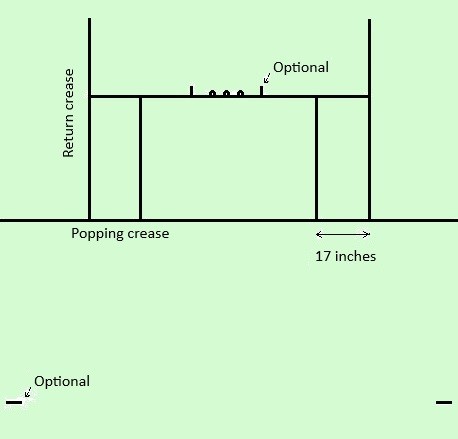
League balls must be used and decent spare balls must be available. The home team provides both new balls and all spare balls.
Teams may provide teas for their opponents and may charge for these. Opponents must be told in advance whether teas are available, but they can turn them down. Hot and cold drinks should be available (or the facility to make these) at the innings interval at no charge.
Electronic scoring is becoming more and more often used, and this is to be encouraged. It is strongly advised that teams are entered on play-cricket some time before the match is due to start. This is a considerable help to scorers.
Teams must have the means to use Duckworth Lewis (Standard). This means there is either a phone, tablet or other computer at the club with play-cricket scorer or PCS Pro installed. (A phone or tablet does not have to be internet connected to calculate DL.)
Captains must fill in a team sheet, using the ECB card if one is available. This is required in the Laws of the Game. Team sheets are handed out at the league pre-season meeting, or obtained from any other source, or printed from the League web site (look in ‘documents’). NB – the team sheets most will have do not reflect new ECB guidelines, now shown in Section M. Instead of age group, the actual age of anyone under 20 must be shown.
If a side has less than 8 players, a game can be played, but it will count as a conceded game.
Before the game starts, the captains must meet to discuss the upcoming game. If there are appointed or non-playing umpires they will be part of the discussion. These topics should be discussed:
The person or club that makes a call to umpires and opponents about delays, cancellations or other match day arrangements must be sure the message has got through, e.g. by actually speaking to someone. Texts / emails / voicemails are not sufficient.
The game must be played in accordance with the Laws of the Game as set out by the MCC, except where League rules override as stated below. ECB guidelines for youth players (over limits, helmets, fielding positions) must be followed.
Unless there is agreement to change, games start at 1pm. For Divisions 1 & 2 games are 45 overs, Divisions below are 40 overs. Bowlers are limited to 20% of the available overs.
Captains may agree beforehand to reduce the number of overs (to a minimum of 20) and start earlier or later. Where the number of overs is reduced, the bowler limits are reduced also, to a maximum of 20% of the overs (NB where the number of overs is not a multiple of 5, e.g. for a 27 over game, bowler limits will be 6,6,5,5,5).
The break between innings should last no longer than 30 minutes. Over rates should average not less than 17 per hour or more than 3½ minutes per over. A 45 over innings should last no longer than 2h45 (that gives about 10 minutes grace). A 40 over innings should last no longer than 2h30 (that gives about 10 minutes grace). 45 over games starting at 1pm should finish by 7pm, 40 over games starting at 1pm by 6.30pm.
A new ball will be used for each innings. If a ball is lost or damaged in the first 5 overs the replacement should be another new ball if possible.
Where there is at least one appointed umpire:
Where there is no appointed umpire:
In Divisions 1-5, fielding circles will be used. There must be 4 fielders, not counting keeper and bowler, inside the circle at the moment of delivery. The square-leg umpire shall call No-Ball
if this rule is infringed. The minimum of 4 applies whether the fielding side has 11 players or not. It is good practice for umpires to try to warn the fielding side before the bowler starts his/her run-up.
Calling of wides (if the ball does not touch the batter or his/her equipment and does not pass between the batter and the stumps):
If the ball in play hits, touches or glances the head or helmet being worn, of any player or umpire, or if a player or umpire is obviously badly hurt, ‘Dead Ball’ must be called immediately. A batter cannot be out bowled, caught, hit wicket or run out, a stumping will not count, if these happen after the ball has struck anyone’s head or helmet being worn. Only runs scored up to that moment stand (e.g. if the ball then crosses the boundary, no boundary is scored.)
Any full pitch ball that passes the popping crease above waist height of the batsman standing upright at the crease is a No Ball. If the umpire (appointed or not) deems it is also dangerous, a first and final warning must be issued to the bowler and fielding captain, and a second dangerous ball of that height means the bowler must be taken off.
Umpires that are not appointed should not call a bowler for throwing unless the bowler very deliberately does not complete their normal delivery action and turns it into a throw. (Appointed umpires are similarly instructed by GACO.)
So-called ‘Mankad’-ing: the first time a bowling team successfully runs out a non-striker when leaving his/her ground early, (i.e. the umpire deems the batter to be out, by the Laws), this will be a warning and the batter will be given not out. If the same thing happens a subsequent time to the same batter, he/she will be given out.
In a close game, what is on the scoreboard is what is played to. The result cannot be changed by spotting a scorebook error after the game has ended according to the scoreboard. Captains are strongly advised to check the scorebook and scoreboard coming up to and during the last few overs in a close game.
If the second innings is curtailed by weather, light or other reason before 20 overs have been completed, there is no result and the game is recorded as ‘abandoned’. Duckworth Lewis (Standard) with a G50 value of 245 is used to determine the winner of an interrupted game where there are at least 20 overs of the second innings.
Players and officials are expected to behave in ways set out in:
These are reproduced in Appendix 2.
Each club must take responsibility for its players with regard to drinking alcohol before and during the game. Captains are reminded of their continuing responsibility (a) for the overall behaviour of their players and spectators and (b) for the welfare of players and officials under 18 years old.
If it’s raining in the morning but a better afternoon is forecast, captains might agree on going for a later start with the away team travelling later to avoid hanging about at the ground.
If the total time lost is less than 15 minutes, it is ignored. Captains and umpires may agree to finish later (up to 8pm in June and July, 7.30pm in April, May and August, September). The tea interval can be shortened by agreement, and if the interval is taken during an interruption, the interval length does not count as time lost.
To avoid hanging around for too long, a game cannot be started after 3.30pm, unless a late start has already been agreed, or both captains agree to wait longer.
Both innings are shortened by 1 over for each 7 minutes of total lost time.
If an interruption (that wouldn’t be ignored by the considerations of para 83) occurs after the start of the first innings, DL will be used to calculate the second innings target even if both innings are the same length.
If the first innings has already exceeded the new number of overs, the innings is closed.
Once a time is set to resume after an interruption that occurs after the first innings, calculate the number of overs that can be bowled (not counting an over still in progress at the interruption), based on 3½ minutes per over, and the agreed finish time. DL will be used to reset the target score. Once the target score is reached, the game is over.
Whenever the number of overs is changed by an interruption, the over limits per bowler are also changed. If a bowler has already exceeded the new limit, he/she may not bowl any more except to complete an over in progress. The calculation is as described in para 67.
Getting used to or preparing to use DL in our games: Teams will all need to be able to use DL on interrupted games. The play-cricket scorer app on a phone or tablet is relatively simple. There is on-line help for how to use it. However, if your club / players / captains / scorers would like it, the GCL can arrange an on-line demonstration by zoom. Please ask your League rep who will pass the request on to a trainer.
The home team is responsible for notifying the away team of a cancellation, stating the reason. Where there are GACO appointed umpires the home team must notify the Umpires.
If it is completely obvious, and both captains agree on this, that there will be no game, because of weather conditions or other problems, a game may be called off up to 48 hours in advance.
Unless the completely obvious
provision, above, applies, Division 1, 2 & 3 games may only be called off in advance of play by one of the appointed umpires or another local GACO umpire. Otherwise, no game can be called off other than by mutual agreement more than 3 hours before the start of the match.
Except for Division 1, 2 & 3 games called off by a GACO umpire, the away team are entitled to refuse a call off at any stage before the start. The presumption must be that all matches will be played.
Away teams must not apply pressure to obtain an early decision to cancel. If the game is still in doubt or there is disagreement between the two clubs, then the away team must travel and both teams must be prepared to play.
If the home team wishes to call the game off, they must invite the away team to inspect and/or offer a reduced overs/later start match. If the away team wishes to challenge a cancellation they must:
When they have been informed that the away team are inspecting the ground, the home side is advised to call on an experienced player or groundsman from another club, or an independent qualified umpire to carry out an inspection. This person can then send a report to the Area Representative.
The League Committee may award a game or impose other penalties if it finds that the home club has improperly called off a game. The League will refuse to accept a report from the away team if the process of para 95 has not been completed.
The opposing team is awarded the game with the maximum points awarded to any team in the same division on the same day, or 20 points if no other games are played in the division.
A team conceding will lose 22 points.
If a team concedes more than 3 times, the Committee will consider whether to delete all past and future games from the season’s record. This is likely to happen for teams above the lowest (Division 9) level. At this level, the Committee may consider that erasing the record and hence discouraging the team to try to carry on is too severe. However, if the concessions continue, the Committee may decide it has no option in fairness to other teams in the Division.
A home team conceded to may ask the Committee to rule that the conceding team should pay compensation for costs incurred. Normal costs for preparing or hiring a pitch are unlikely to be compensated. But if, for example, a tea was expected and had been prepared, a claim could be made.
Conceding by a higher team in a club while fielding a lower team is strongly deprecated. However, if it happens, all other teams of the club that actually play a GCL League game on that day will be penalised 5 league points, though their results will stand.
Match points
Bonus points are normally based on scoring 100, 125 etc runs up to 200, and every two wickets taken. However, the thresholds are lowered if an innings is limited to fewer overs than usual by agreement or interruptions as in section H. The full tables are, therefore:


For clarity, overs available
means the number of overs that were potentially available, taking into account any agreed reductions, just before the last actual ball of the innings was bowled, whether the innings was completed or abandoned.
If a team declares or is all out with less than 11 players, maximum bowling points are awarded.
Play-cricket attempts to insert the batting and bowling points. It doesn’t always get them right, but the League appoints results admins who will check and correct in due course. Please only contact your Area Representative about apparently incorrect points if they still seem to be wrong after a day or so.
League tables will be ordered by total points. At the end of a season, if teams are level on points, then net run rate will be used to put them in order.
In some circumstances, in Div 9 level, e.g. in a division with 11 sides, teams may not have the same number of games scheduled. If this is the case, the league table will be ordered by average points per completed game, cancelled and abandoned games being omitted from the calculation.
The HOME team must ensure the summary result is on play-cricket before the relevant deadline, see below, but of course the away team can put the result in.
EACH TEAM must ensure that all its players are registered and showing on play-cricket and that both scorecards are as complete as possible before the relevant deadline. The HOME team takes the rap If the scorecards are incomplete apart from unknown
s in the away team, but either team can complete the scorecard partially or completely.
A great advantage of on-line electronic scoring is that the result, registered player names and scorecards are automatically completed on play-cricket immediately.
However, note that both the play-cricket scorer (on phones and tablets) and PCS Pro on laptops can create
names for unregistered players. At first glance the scorecard looks complete, but the player name shows up in a different colour on the scorecard, and a play-cricket administrator will see an action Team sheets containing free text players
, which is also flagged up to the League admin, and is equivalent to unknown
or unregistered. The club results person will need to change this entry to point to the true registered player, by the deadline.
Where there are appointed umpire(s) BOTH captains must complete a report on WTU on both umpires, by the relevant deadline.
The AWAY captain must complete a ground report by the relevant deadline.
BOTH captains must complete Fair Play reports by the relevant deadline.
If a Fair Play report has a mark of 1 (unacceptable) there must be a disciplinary report. In this case, or if there is an allegation not arising from Fair Play, the club making the allegation must submit a disciplinary report to the League Disciplinary Officer, using the GCL Disciplinary Form. An official of the alleged offender’s club must be told on the day of the game that a mark of 1 and a report will be made. The Disciplinary report must be submitted by Wednesday 7pm after the game. Failure to meet this deadline, or failure to notify the alleged offender’s club on the day of the game will mean that no action will be taken by the League, and a Fair Play mark will be changed to a 2 by the League. However, the league will act anyway if the report is of an alleged level 3 or 4 offence.
These are:
Failure to meet a deadline will be dealt with a warning (first time), then increasing numbers of league points deducted, i.e. repeat offenders are hit harder. See Section O.
The following are extracts from the ECB guidelines – please see the ECB web site for the complete wording. Though they are called guidelines, these will apply to all League games.
Age restrictions: A child whose actual age is 12 or older may play in GCL games as long as there is parental permission and the club has considered the guidelines above. Exceptionally, a player who is 11 years old in a County squad my play with written approval from the County Talent Pathway Lead.
All under the actual age of 18 must wear a helmet with face guard when batting. All under the actual age of 18 must wear a helmet with face guard when keeping standing up to the stumps. Male youth players must also wear a box whenever they are required to wear a helmet.
Players 13 years older or younger may not field closer than 11 yards from the bat, except behind square on the off side. Players aged 14 or 15 may not field closer than 8 yards, except behind square on the off side.
Players aged 16 or 17 must wear a helmet with face guard, and boys must wear a box, when fielding closer than 6 yards from the bat, except behind square on the off side.
These restrictions apply to young fast and medium pace bowlers, relative to their own age group. They do not apply to someone who would be considered, within their own age group, to be a slow bowler.
| Age | Max overs per spell | Max overs per day |
| 11 | 4 | 8 |
| 12 & 13 | 5 | 10 |
| 14 & 15 | 5 | 12 |
| 16 & 17 | 6 | 15 |
| 18 & 19 | 7 | 18 |
For clarity, if a young bowler is taken off (excluding simply changing ends) having bowled fewer overs in the spell than the maximum, they must not then bowl again until the same number of overs has been bowled by someone else from the same end, e.g. if a 16 year old bowls overs 1, 3, 5, 7 (4 overs) and is then taken off, they may not bowl until overs 9, 11, 13 and 15 (4 overs) have been bowled.
GACO will appoint umpires to as many games as possible, filling Division 1 appointments before Division 2 and so on. Each GACO appointed umpire will receive an attendance fee (Div 1 £55, below Div 1 £50 for the 2025 season), which will be invoiced to clubs on Play-Cricket by the League at set points during the season. Fees are set by GACO.
If only one GACO appointed umpire is available, he/she will operate from the bowlers end throughout the match (the fee is for Div 1 £80, below Div 1 £70 for the 2025 season). It is the responsibility of both captains to agree an umpire at the striker's end. If the captains and GACO appointed umpire agree, the replacement umpire may stand as a full umpire.
Where there are no GACO appointed umpires, both sides have the right appoint one umpire, whether they are batting or bowling. (NB a side can appoint
an umpire who is affiliated in some way to the other side.) A side can appoint one of their own players, and can change umpires during the game (i.e. the normal arrangement if there are no other umpires available). If the side fielding cannot appoint their own umpire, because they are all in the field, then their right to appoint an umpire passes to the batting side. If a team has a non-playing umpire, this person will normally stand for the whole game, and the other team has no right to refuse this. In any case the umpiring arrangements must be discussed by the captains before the game.
Whoever actually stands is, at that time, The Appointed Umpire. All umpire's decisions must be accepted and implemented. Dissent during or after the game, in all cases, whoever is the umpire, must be reported to the League Committee by the by the GACO appointed umpire or the team that appointed the umpire. A ban will normally be applied on players showing dissent, and can also be applied to the captain, who is responsible for ensuring his/her side plays by the Spirit of the Game.
Clubs may make an official complaint about any umpire*. The complaint must name the umpire and by whom the umpire was appointed and give firm evidence to back the complaint – remembering that any umpire can be wrong at times. Complaints about GACO appointed umpires will be passed to GACO. Otherwise, the Committee will note the complaint, and if a consistent and convincing picture emerges from more than one complaint, the League may investigate and may ask that the umpire is not appointed or other remedial action.
* The League will largely ignore comments on umpire’s judgement calls: didn’t give a couple of stone-dead LBWs
, everyone heard the nick, given not out
and the like. It’s only if an umpire is named and somehow there is really solid evidence (a video is unlikely to be good enough) of poor umpiring that the League can possibly do anything.
Unless the captains agree otherwise, a person under the age of 18 cannot stand as umpire at the bowler’s end unless they have successfully completed a formal umpiring course, introductory or higher. Young people may stand at the striker’s end.
Non-playing umpires should have successfully completed a formal umpiring course, introductory or higher.
This document is full of ‘must’, ‘will’, deadlines etc., and to be meaningful there need to be sanctions or warnings applied when a rule is broken or a deadline missed.
Poor behaviour is covered in the next section on the Disciplinary Process. The Committee, or a League Official may, in addition, decide that an instance of rule breaking should also be dealt with by the same Disciplinary Process.
If a team is found to have included a player who was not eligible to play, even if the player was registered, the offending team will have all league points for the game removed. If the offending team won the game, the result will be reversed, the other team gaining 10 points for a win, though other bonus points will not be altered.
Missing a deadline for entering a result, sending in a report, applying for player registration, completing a scorecard (OK to have unsure or free text for a new player awaiting registration), failure to clear scorecard unsure and free text names by the later deadline of para 117:
The team captain may make an appeal to the Area Representative explaining why the warning or penalty should be revoked. The Area Representative’s decision (after consulting others on the committee) will be final. Multiple missed deadlines for the same match count as only a single fault. The penalties of the paragraph above will not be applied retrospectively, that is to say that if no League official spots a missed deadline by the time the missing action is completed, no offence is deemed to have occurred.
In any other cases than those above, where the rule breaking is not about behaviour or is not dealt with under the Disciplinary Process, the Committee will deal with it or appoint a sub-committee or an individual to do so, and set out tariffs for sanctions.
The GCL follows the ECB Recreational Cricket Regulations (RCR) which govern the conduct of disciplinary investigations. The process described below meshes with the RCR. The League will appoint a Disciplinary Officer who takes the lead on handling an alleged offence.
The Disciplinary process starts when there is an incident of misconduct or a breach of league rules occurs. If the incident or breach is to be dealt with by the league’s process, the league must receive formal notification. Complaints arising from incidents associated with a match must normally be notified to the league by 7pm on the Tuesday after the game (except for extremely serious incidents such as actual violence or child abuse where there is no time limit). As stated in paras 63 and 116, the club being sited must be informed on the day of the offence. To be official, notification of a dispute or complaint must come from either:
A Captain’s Role and Duty regarding Discipline:
Captains must note that the Laws of Cricket state that they are responsible at all times for ensuring that play is conducted within the Spirit of the Game as well as within the Laws
. The captains must be trying to intervene, de-fuse and calm the situation, and early intervention is important. The two captains need to be working together on this and be seen to be working together. Talk about discipline before the game starts. After the game discuss the incidents and potential disciplinary reporting.
Unless agreed otherwise with the Disciplinary Officer, reports about incidents in a match must use a standard form supplied by the league (on the web site). This is to be sent to the Disciplinary Officer.
On receipt of a complaint, the Disciplinary Officer will take control of the process, using the RCR. The RCR process is shown in Appendix 1 below.
At all stages in a disciplinary investigation, clubs and individuals will be required to respond to a request or order from the Disciplinary Officer within 7 days of receipt of the request or order.
Result points cannot be altered in a disciplinary process where there an allegation about some advantage / disadvantage / bias during the game.
(Shown here are extracts from the full RCR documents. In dealing with actual disciplinaries one should always read the full RCR)
3. Any cricketer shall be in breach of these RCR, at the relevant level of offence detailed below, if they do not conduct themselves fairly and properly on and around the field of play and otherwise in accordance with the Laws of Cricket or the Spirit of Cricket. Such conduct which will result in a breach of these RCR shall include any misconduct of a cricketer on any match day as specified in Law 42 of the Laws of Cricket, namely:
Levels 3 and 4 offences relate to threats of and actual physical violence against a person.
6. If any cricketer commits two or more breaches of Regulation 3 (Conduct obligations on and around the field of play), which take place during or immediately before or after a match, when playing for the same Club in a season it shall automatically be a separate offence of failing to ensure that the relevant cricketers have complied with their obligations for each of:
8. A Participant shall be in breach of these RCR if they commit any misconduct as set out below which either relates to their participation in Recreational Cricket and/or is of a sufficiently serious nature to justify disciplinary action being taken in relation to their participation in Recreational Cricket:
9. Participants are considered responsible for any relevant posts on their social media accounts and may be in breach of RCR 8 for posting, repeating, commenting or supporting posts or comments by others (e.g. ‘retweeting’ or ‘liking’) on social media that amount to a conduct breach under Regulation 8.
13. Relevant Cricket Leagues must ensure that any disciplinary processes conducted under these RCR comply with the following requirements:
14. The Participant shall have the opportunity to appeal any decision. Relevant Cricket Leagues must ensure that any appeal processes conducted under these RCR comply with the following requirements:
The table below sets out recommended sanctions to be applied on Participants in respect of On-Field Breaches. However, the Disciplinary Chair or Disciplinary Panel shall not be limited to imposing the recommended sanctions and can impose greater or lesser sanctions as appropriate in the circumstances of the particular case.
| Level of Offence | First offence | Second offence within 24 months | Third offence within 24 months |
| 1 | 2 match ban | TBD | TBD |
| 2 | 4 match ban | TBD | TBD |
Bans will apply to all cricket, be effective immediately and remain on the Participant’s record for 24 months from the date of the breach.
A ban expires when the Participant’s team has played the number of League games stated in the ban.
Cricket is a game that owes much of its unique appeal to the fact that should be played not only within its Laws but also within the Spirit of the Game. Any action which is seen to abuse this spirit causes injury to the game itself. The major responsibility for ensuring the spirit fair play rests with the captains. There are two Laws which place the responsibility for the team's conduct firmly on the captain.
The captains are responsible at all times for ensuring that play is conducted within the Spirit of the Game as well as within the Laws.
In the event of a player failing to comply with instructions by an umpire, or criticising by word or action the decisions of an umpire, or showing dissent, or generally behaving in a manner which might bring the game into disrepute, the umpire concerned shall in the first place report the matter to the other umpire and to the player's captain, and instruct the latter to take action.
1 According to the Laws the umpires are the sole judges of fair and unfair play. The umpires may intervene at any time and it is the responsibility of the captain to take action where required.
2 The umpires are authorised to intervene in cases of:
3 The Spirit of the Game involves RESPECT for:
4 It is against the Spirit of the Game:
5 There is no place for any act of violence on the field of play.
6 Captains and umpires together set the tone for the conduct of a cricket match. Every player is expected to make an important contribution to this.
1 The captains are responsible at all times for ensuring that play is conducted within the Spirit of Cricket as well as within the Laws.
2 Players and team officials must at all times accept the umpire’s decision. Players must not show dissent at the umpire’s decision or react in a provocative or disapproving manner towards another player or a spectator.
3 Players and team officials shall not intimidate, assault or attempt to intimidate or assault an umpire, another player or a spectator.
4 Players and team officials shall not use crude and/or abusive language (known as sledging
) nor make offensive gestures or hand signals nor deliberately distract an opponent.
5 Players and team officials shall not make racially abusive comments nor indulge in racially abusive actions against fellow players, officials, members and supporters. Clubs must operate an active open door membership policy whilst respecting player qualification regulations and welcome players/members irrespective of ethnic origin.
6 Players and team officials shall not use or in any way be concerned in the use or distribution of illegal drugs.
7 Clubs must take adequate steps to ensure the good behaviour of their members and supporters towards players and umpires.
Umpires’ decisions are matters of opinion and complete agreement is unlikely. But we expect batsmen to leave the field promptly and bowlers to get back to their mark. Mistakes will be made, but dissent will not help anyone.
We’re not surprised by frustrated expletives when something goes wrong (dropped catch, beating the bat regularly etc.) but this should not be heard beyond the immediate area of the pitch.
If players want to contribute vocally, make sure the comments are aimed at encouraging their own team and not clever remarks about the opposition aiming for a cheap laugh or to undermine the opponent.
GO INDOORS IMMEDIATELY if:
DO NOT:
WHEN TO RESUME:
DANGER SIGNS:
There is imminent danger of a lightning strike if:
REMEMBER – THERE IS NO SAFE PLACE OUTSIDE IN A THUNDER STORM
Never lie flat on the ground during a lightning storm. Although the ‘Lightning Squat’ (crouching low with hands over head and ears and elbows on knees) has been mentioned by some as a last resort it doesn’t work. If you can get into a sturdy building or a car do this at once.
* the ’30/30 Rule’ – by no means infallible but a good guideline. Get indoors when thunder is audible within 30 seconds after you see the associated flash (the ‘flash to bang time’) and don’t venture out until thunder has not been heard for 30 minutes.